what time should you get married
in Jamaica?
The single decision that changes your photographs and your film more than any other — and the reason "an hour before sunset" is not, on its own, an answer.
Almost every couple planning a Jamaica wedding is given the same piece of advice: hold the ceremony about an hour before sunset. It is good advice. It is also incomplete, and following it without understanding why is how couples end up doing family photographs in the dark.
Here is what the ceremony time actually controls.
Why the middle of the day is the hard part
Jamaica is closer to the equator than most of the places our couples travel from, which means the sun climbs higher and sits overhead for longer. Between roughly late morning and mid-afternoon it comes almost straight down. In practice that means deep shadows in eye sockets, blown-out highlights on a white dress, dark suits losing all their texture, and a wedding party squinting through the vows.
None of that is unfixable — it is our job to handle it, and a midday ceremony under shade or indoors can photograph beautifully. But it is worth knowing that midday is the one time of day where the location is working against the pictures rather than for them.
What changes in the last two hours
From mid-afternoon onwards the sun drops, the light travels through more atmosphere, and it warms and softens. It also starts coming from the side rather than from above, which is what gives faces shape. The same ceremony lawn genuinely looks like a different venue at 5:30 than it did at 1:00.
This is the window everyone means when they say "golden hour". The trouble is that the window is not the same length everywhere in Jamaica, and it is not the same length all year.
Why sunset time alone is not enough
Two things people forget:
- Which way your venue faces. A west-facing cliff in Negril loses its light abruptly — the sun goes into open water and there is nothing to bounce it back. A north-facing beach on the Montego Bay side declines much more gently. Same sunset time, materially different amount of usable light afterwards.
- What has to happen after the vows. A ceremony is the start of a sequence, not the end of one. Family groups, couple portraits and any travel between locations all have to fit into whatever light is left.
Work backwards, not forwards
The most useful thing a couple can do is build the afternoon backwards from sunset rather than forwards from the ceremony. Roughly, and this varies with the size of your family and the layout of the venue:
- Couple portraits in the best light — the last 30 to 45 minutes before sunset.
- Family and group photographs — before that, while everyone is still together and the light is still bright enough to work quickly.
- Ceremony — before that again, with enough margin that a late start does not eat the portrait window.
Which is how couples arrive at a mid-to-late afternoon ceremony. Not because there is a magic number, but because that is where the arithmetic lands once everything after it is accounted for.
Weather, honestly
We are not going to publish rainfall statistics we have not measured. What we will say from experience is that Caribbean afternoon weather can change quickly, that a passing shower is far more common than a washed-out day, and that overcast light is often kinder to faces than hard sun. A cloudy ceremony is not a photographic problem. An unplanned two-hour delay is.
Ask your venue what happens if it rains, and ask early. That is a venue question, not a photography one, and the good properties have a real answer.
The one rule that survives every venue
Whatever time you choose, protect the gap between the ceremony and the portraits. It is the first thing that gets compressed when a day runs late, and it is the only part of the schedule that cannot be moved later, because the sun will not wait for a processional that started twenty minutes behind.
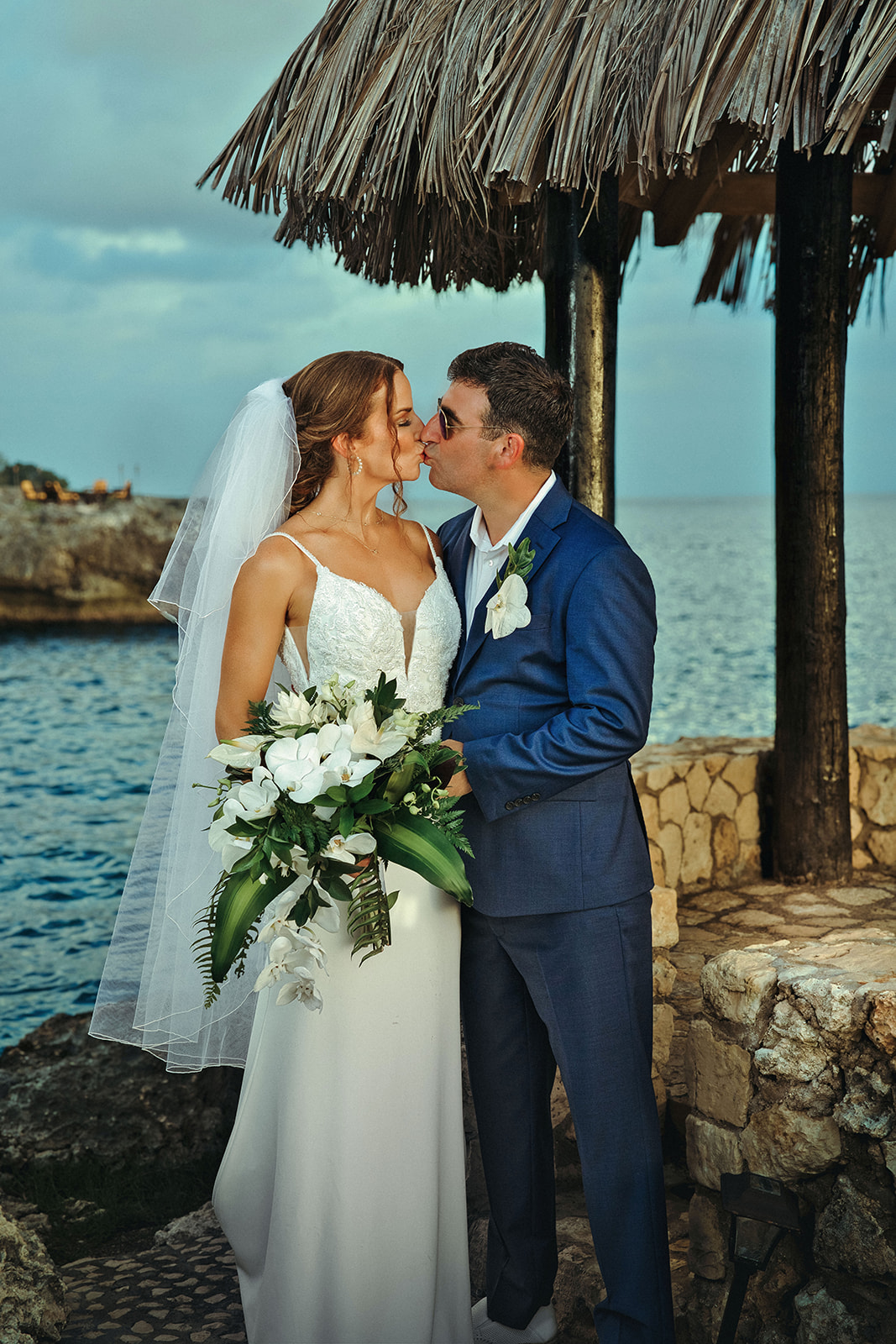
what this looks like in practice.
Samantha and Brian's ceremony at Tensing Pen was set for golden hour on a west-facing cliff — the least forgiving version of this problem. Everything that day was planned backwards from the moment the sun hit the water.
next.
not sure what time to set?
Send us your date and venue. We will tell you what the light will be doing and what we would plan around.
Check your date →